
Retatrutide: The Triple Agonist Deep-Dive
Written against the cited studies. Last updated 25 Jun 2026
Key takeaways
Retatrutide is Eli Lilly's investigational once-weekly triple agonist, the first compound to switch on the GLP-1, GIP and glucagon receptors at once. The glucagon arm is what nothing else in the class has. In trials it posted the largest non-surgical weight reductions on record. It is in Phase 3, not yet approved anywhere, and supplied as a research compound.
Fat metabolism comes down to one thing at the core: energy in versus energy out. Take in more energy (calories) than is burned and the surplus is stored as fat; burn more than is taken in and the body dips into the stores. It is basic thermodynamics. GLP-1 receptor agonists act mainly on the "energy in" side, lowering appetite so less is eaten. Retatrutide's third receptor adds the "energy out" side too, and the energy frame is how to read every number below.
In trials, retatrutide moved the weight-loss ceiling for the class. Semaglutide reported around 15% in its trials, tirzepatide past 20%, and retatrutide's Phase 3 topline reported figures nudging 30%, the largest non-surgical weight-loss result on record. It still goes by its lab name, LY3437943, because Eli Lilly has not branded it yet, and as of mid-2026 it is not approved anywhere in the world. That combination, the strongest data in the category sitting on top of the thinnest long-term safety file, is exactly what this guide is here to unpack.
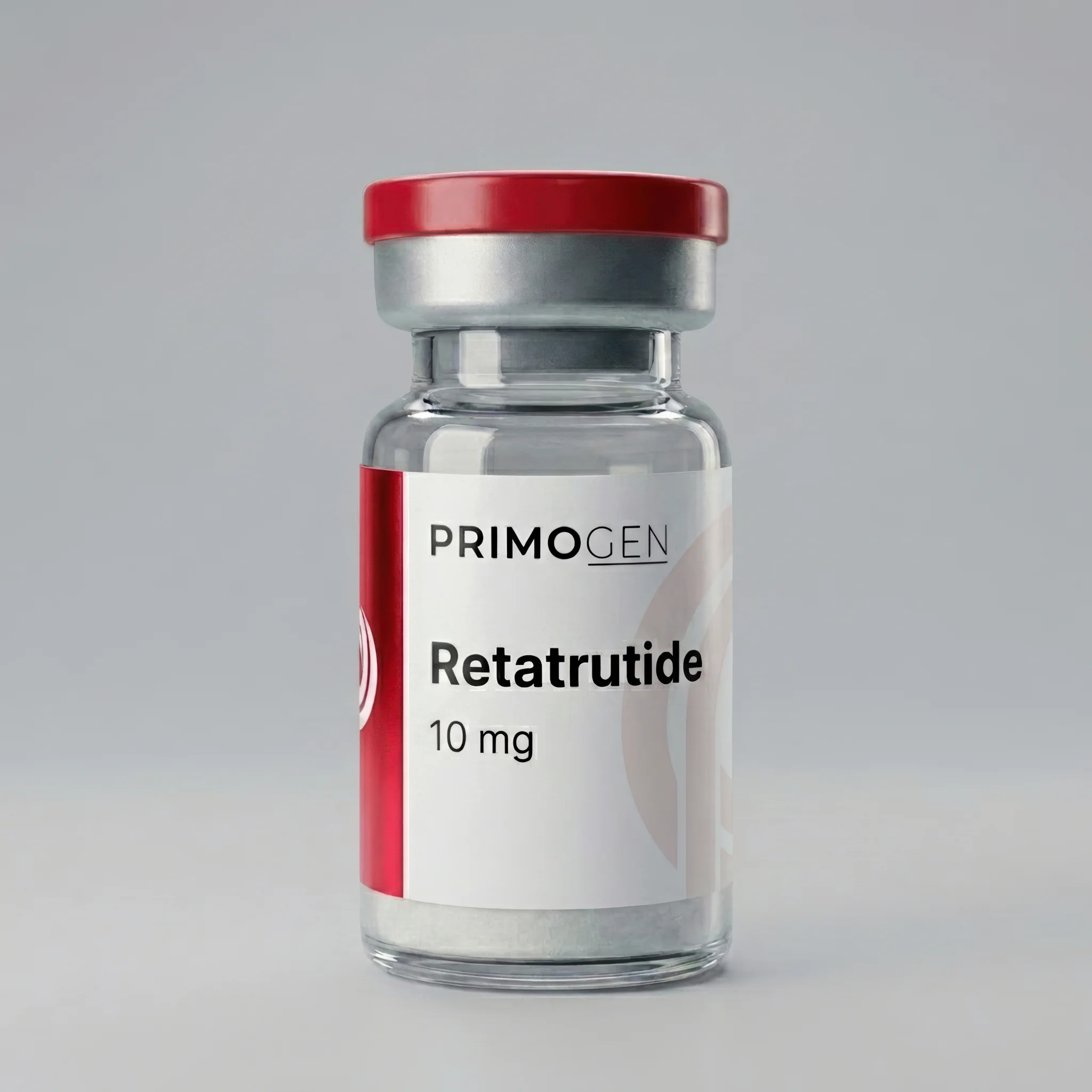
Primogen stocks retatrutide. The reasoning is the same one the rest of this article makes: across the published trial readouts for weight, liver fat, lipids and metabolic rate, it leads the GLP-1 class on the numbers. There is no "earn your way up from tirzepatide first" ladder here. But leading on data and being fully de-risked are two different things, and we will be straight about both.
What is retatrutide?
Retatrutide is a single-chain peptide engineered by Eli Lilly to agonise (switch on) three receptors at once: the GLP-1 receptor, the GIP receptor and the glucagon receptor. Receptors are the docking points on your cells that a hormone plugs into to give an instruction, and an agonist is a molecule that switches one on. GLP-1, GIP and glucagon are all gut and metabolic hormones your body releases around mealtimes. That is what "triple agonist" means, and it is one molecule doing all three jobs, not a blend.
For context on how it sits against the compounds you have already heard of, all three of the big weight-loss drugs are mimics of the gut hormones your body releases after a meal. The difference is how many receptors each one engages:
- Semaglutide (Ozempic, Wegovy) is a single agonist: GLP-1 only.
- Tirzepatide (Mounjaro, Zepbound) is a dual agonist: GLP-1 plus GIP.
- Retatrutide is the triple: GLP-1 plus GIP plus glucagon.
As a rule of thumb in this class, more receptors means more total fat lost and more to keep an eye on. Retatrutide is the clearest illustration of that rule. The full side-by-side lives in Retatrutide vs Tirzepatide vs Semaglutide; this guide goes deep on retatrutide alone.
How does retatrutide work?
Retatrutide works by agonising three receptors at once, and the glucagon arm is the differentiator. In cell and animal studies the GLP-1 and GIP arms drive the appetite and insulin-sensitivity effects shared with semaglutide and tirzepatide, while the third receptor, glucagon, adds a metabolic-rate and liver-fat mechanism the other two compounds do not engage. The GLP-1 and GIP arms do roughly what you would expect. GLP-1 receptor agonism quietens hunger signalling in the brain and slows gastric emptying (how fast food leaves the stomach). GIP agonism rides alongside it and, in the trial data, appears to reduce the nausea seen with GLP-1 alone. Between them, the mechanism lowers appetite and improves glycaemic control. That is the same receptor engine semaglutide and tirzepatide run on.
The third lever, glucagon, is what changes the character of the drug. Most people associate glucagon with raising blood sugar, but at the receptor level its metabolic job is the interesting part. Glucagon-receptor agonism does three things the other two compounds cannot:
- It raises resting energy expenditure (the calories burned at rest just to stay alive) in the study models.
- It drives lipolysis, the breakdown of stored fat.
- It reduces liver fat, the mechanism behind retatrutide's standout liver-fat trial numbers.
Put simply: the semaglutide and tirzepatide mechanism acts mainly on appetite. Retatrutide's mechanism acts on appetite and, via the glucagon arm, on metabolic rate.
Lilly tuned the receptor balance deliberately. Per Coskun et al. 2022 (Cell Metab), the relative potencies versus the native hormones are GIP 8.9x, GLP-1 0.4x and glucagon 0.3x, GIP-biased with restrained glucagon activity, the point being to engage the fat-mobilising glucagon pathway without unopposed glucagon raising blood sugar.
One honest nuance, because the marketing version glosses over it: milligram for milligram, the trial data shows retatrutide is slightly less potent on appetite suppression than tirzepatide, and that effect can fade marginally faster. Its mechanistic edge is the number of pathways it engages at once, not stronger appetite suppression.
What does the clinical data show?
The clinical data shows retatrutide producing the largest weight reductions reported in the GLP-1 class, alongside marked changes in liver fat, lipids, blood pressure and glycaemic markers across Phase 2 and Phase 3. Here are the real numbers with the real sources.
How much weight did retatrutide produce in trials?
In the trials, retatrutide produced a mean -24.2% body weight at 48 weeks on 12 mg in Phase 2, and Phase 3 topline figures of roughly -28% to -30% at 80 weeks, the largest non-surgical weight-loss result reported in the class.
- Phase 2 (Jastreboff et al. 2023, NEJM): -17.5% at 24 weeks and -24.2% at 48 weeks on 12 mg. The loss curve had not plateaued by the end of the trial, which is unusual and notable.
- Phase 3 TRIUMPH-1 topline (reported May 2026): around -28.3% at 80 weeks on 12 mg, with figures up to ~30.3% reported in longer-duration, higher-BMI maintainers. That is the strongest non-surgical weight-loss result on record.
- Phase 3 TRIUMPH-4 topline (Dec 2025): -28.7% body weight in an obesity-plus-knee-osteoarthritis population, alongside a large reduction in joint-pain scores reported in the trial.
Two things to keep honest. First, the Phase 3 figures are topline data straight from Lilly, not full peer-reviewed papers yet, so treat them as very promising rather than carved in stone. Second, trial numbers come from supervised dosing with proper titration (raising the dose gradually in steps) and support behind them; real-world results are usually a bit lower.
What does retatrutide do beyond weight loss?
Beyond weight, the Phase 2 trial data reported large reductions in liver fat, triglycerides, LDL cholesterol, blood pressure and HbA1c on 12 mg, most of it peer-reviewed:
- Liver fat: an 82.4% relative reduction in liver fat on 12 mg at 48 weeks (Sanyal et al. 2024, Nature Medicine), notable for fatty-liver (MASLD) research and attributed to the glucagon axis.
- Triglycerides: a mean ~40% reduction at 48 weeks on 12 mg (Jastreboff ADA 2023 presentation, per Healio coverage).
- LDL cholesterol: a mean ~22% reduction over the same window.
- Blood pressure: mean systolic blood pressure fell roughly 14 mmHg on 12 mg.
- Glycaemic markers: in type 2 diabetes, mean HbA1c fell by up to ~2.16%, with 82% of participants reaching the sub-6.5% target (Rosenstock et al. 2023, Lancet).
- Metabolic rate: unlike the other two compounds, the trial data reported a rise in resting energy expenditure rather than appetite suppression alone.
How big is the retatrutide trial program?
The retatrutide trial program is large: the TRIUMPH series runs from TRIUMPH-1 through TRIUMPH-8, covering obesity, type 2 diabetes, osteoarthritis pain and weight-loss maintenance, plus a dedicated cardiovascular-outcomes trial (TRIUMPH-Outcomes, NCT06383390) enrolling on the order of 10,000 people. That is the exact road semaglutide and tirzepatide walked before they became household names. Approval is widely expected, and when it lands, retatrutide will almost certainly pick up a brand name of its own. Until then it sits in the research-compound window under its original name.
How is retatrutide dosed?
Retatrutide is a once-weekly compound, and in trials it was titrated up slowly over months rather than started at the target dose. The Phase 2 and Phase 3 trials escalated 2 to 4 to 6 to 9 to 12 mg, stepping up every four weeks, with maintenance arms at 4, 9 or 12 mg, in subjects with obesity. Those are the maximal-result trial doses, not a general template, and the top of that range is advanced-only territory.
One detail worth knowing, because it drives tolerability in the data: in Phase 2, a 2 mg start instead of 4 mg sharply reduced early nausea (17% versus 60% at the 8 mg target). In the trial record, the rate of the titration is the single biggest factor in early gastrointestinal tolerability.
Community-practice protocols, as opposed to the trial schedule, run gentler. The pattern practitioners and experienced users describe is a microdose start of roughly 0.25 to 0.5 mg weekly, holding two to four weeks per step, and settling somewhere in the 1.5 to 4 mg per week range, roughly half the trial pace. Many also describe splitting the weekly dose into two smaller injections (for example half on day one, half on day four) to flatten the peak-to-trough swing. These are reported community conventions, not validated protocols.
Microdosing deserves a flag of its own, because it is widely discussed and widely overstated. A subset of the community now runs small, sub-clinical weekly doses aimed at the metabolic-rate and liver-fat axis rather than maximal weight loss. What is not supported by the data is the claim that a 1 mg microdose gives "80% of the effect": in Phase 2 the 1 mg arm reported 8.7% weight loss at 48 weeks versus 24.2% on 12 mg. The lower dose is not the full trial effect at a fraction of the dose.
If you are new to reconstituting (mixing the dry powder with liquid to make an injectable solution) and dosing a lyophilised (freeze-dried) peptide, the practical walkthrough is in how to reconstitute and dose. The short version: Primogen supplies bacteriostatic (BAC) water for reconstitution, retatrutide is dosed subcutaneously, meaning injected into the fat just under the skin (abdomen, thigh or upper arm), and grey-market vials commonly come as 5 to 30 mg lyophilised cakes, frequently reconstituted to around 5 mg/mL.
What are the side effects of retatrutide?
In the trials, retatrutide's side effects were mostly gastrointestinal, dose-dependent and worst during titration, with the highest reported burden of the three compounds plus two signals largely its own: a larger heart-rate rise and a novel skin-sensation effect. The profile is the same shape as the rest of the class but more pronounced.
- Nausea is the most common. On 12 mg it ran around 45% in trials, climbing as high as 60% with fast titration, and as low as ~14% at the lowest doses. Vomiting, diarrhoea and constipation followed the same dose curve at lower rates.
- Heart rate is the signal to weight most. Mean resting heart rate rose about 6 to 11 bpm in trials, around 6.7 bpm at the higher Phase 3 doses, materially more than tirzepatide's 2 to 3 bpm or semaglutide's 3 to 4 bpm. It tended to peak around week 24 and ease back a little after. This is the figure to study closely against a sensitive cardiovascular profile.
- Dysesthesia (odd skin sensations, tingling or hypersensitivity) is a side effect largely unique to retatrutide in the trial record. It was reported in about 20.9% of participants on 12 mg in the TRIUMPH-4 Phase 3 readout, versus under 1% on placebo. It was rarely severe enough to drive discontinuation, the mechanism is not fully understood, and it is not a "bad batch" artefact.
- Rare but serious: pancreatitis and gallbladder events are class-wide risks across all GLP-1 drugs. There is also a class-level thyroid C-cell tumour warning carried over from rodent studies, with no human cases reported.
- Discontinuation: adverse-event-related dropout ran around 6 to 16% across Phase 2 dose groups, and 11.3% on 12 mg in TRIUMPH-1.
The under-appreciated finding is lean-mass loss. The DXA body-composition substudy (Coskun et al. 2025), DXA being the body scan that separates fat from muscle and bone, is blunt: retatrutide's fat-to-lean loss ratio was similar to other incretin drugs (the GLP-1/GIP family of gut-hormone mimics) in the trial, not better, despite the glucagon arm. Because it removed more total weight, the absolute lean mass lost was larger. The glucagon component did not preferentially spare lean mass in the data. Adequate protein intake and resistance training are the conventional levers researchers and the community cite for protecting lean mass during a large energy deficit.
Who is retatrutide for?
The research and community interest in retatrutide clusters around a few profiles:
- Large weight-loss research goals, particularly where tirzepatide or semaglutide had plateaued. The community calls this the "Tirz-plateau jump" and it is a common 2026 talking point.
- Metabolic-research interest beyond the scale, fatty liver, triglycerides and glycaemic markers, where the glucagon-driven trial signals are strongest.
- Biohackers focused on the resting-energy-expenditure and liver-fat axis, often via lower microdoses, in exchange for a smaller appetite effect and fewer reported side effects.
- Once-weekly convenience, with minimal handling overhead. Community reports also describe low-dose use centred on the appetite and "food noise" effect rather than large weight change.
It is a poorer fit where there is a sensitive cardiovascular profile (the heart-rate rise is well-documented), a need for the most established safety track record, or no way to maintain the protein intake and resistance training that the data suggests matters for lean mass.
What is the food-noise and cravings research?
The "food noise" effect is the reduction in constant background chatter about what and when to eat next, and lowering it is the best-characterised action of the GLP-1 class in the research literature. Across the class, community reports also describe improved focus and less food-related preoccupation, though this is self-reported rather than a measured trial endpoint for retatrutide specifically.
There is a more striking, still-emerging research signal worth flagging honestly. These compounds act on the brain's reward and dopamine pathways, the same circuitry implicated in cravings of many kinds, not just food. Across the GLP-1 class there is growing research interest in reduced cravings beyond eating: alcohol most of all, with human studies now underway, and reports around other compulsive behaviours from nicotine to gambling. This is not confirmed in the retatrutide trials specifically and sits at the hypothesis end of the evidence, so treat it as something researchers are actively studying rather than a settled effect.
The same reward-pathway action is reported to cut both ways. Some users describe reduced motivation, drive or libido, particularly at higher doses. As with most of retatrutide, the pathway behind the upside is the same one to monitor.
What are the caveats and risks of retatrutide?
The main caveats are that retatrutide is the newest compound in the class, has no human safety data beyond roughly two years, has no cardiovascular-outcomes data until around 2030, holds no regulatory approval anywhere, and sits in a sector with thin per-batch testing. Here they are plainly, the part competitors skip.
It is the newest, with the least long-term safety data. Phase 2 ran to 48 weeks; Phase 3 has reported out to 80 to 104 weeks in subsets. There is no human safety data beyond about two years, and the cardiovascular-outcomes data will not be in until the TRIUMPH-Outcomes trial wraps up, around 2030. Given retatrutide's larger heart-rate rise, that is not a footnote.
No approval anywhere yet. As of mid-2026 retatrutide has zero regulatory approvals in any jurisdiction, including Indonesia. It is sold as a research compound, "not for human consumption", and the long-term post-market safety net that backs an approved drug simply does not exist for it yet.
Sourcing reality, since the industry stays quiet about it. Research peptides overwhelmingly come out of China, and proper per-batch third-party testing is thin across the whole sector. Some vendors publish a third-party HPLC certificate of analysis, many do not, and purity has varied widely. To be clear about where Primogen stands today: it does not yet run its own testing, that is on the roadmap as it scales. For now, where a figure exists it comes from the supplier's own reference-batch COA, and a reference COA describes a reference batch, not necessarily the vial in your hand. Read whatever certificate comes with what you buy and know what it does and does not prove.
Weight regain after stopping is documented across the class. Retatrutide-specific cessation data has not been published, but by direct class analogy, semaglutide trial participants regained roughly two-thirds of their lost weight within a year (Wilding et al. 2022, STEP 1 extension), and tirzepatide participants regained a comparable share after withdrawal (Aronne et al. 2023, SURMOUNT-4). The research framing is that these are long-term tools, and the trial extensions point to training and eating habits as what holds a result after discontinuation.
How does retatrutide compare across the range?
Across the range, retatrutide leads on the published trial numbers for weight and the wider metabolic markers, while tirzepatide leads on approval status, safety history and milligram-for-milligram appetite suppression. There is no "graduate up from a milder compound first" requirement implied by the data; the trade-off is being on the newest compound while its long-term track record is still being written.
For the FDA-approved option with the longest safety history, a smaller heart-rate signal and the strongest milligram-for-milligram appetite suppression in the data, tirzepatide is the comparison point, and stocked for exactly that reason. The full case is in the Tirzepatide deep-dive. Semaglutide, for the record, Primogen does not stock; the two stronger options lead it on the data.
Referenced products
Take the 2-minute protocol quiz for a recommendation tailored to you.
Build your stackFrequently asked questions
What is retatrutide?
It is Eli Lilly's investigational once-weekly triple agonist, the first compound to hit the GLP-1, GIP and glucagon receptors at once. The glucagon arm is what sets it apart mechanistically: in the trial data it is associated with a rise in resting energy expenditure and a large reduction in liver fat, a pathway the GLP-1-only and GLP-1/GIP drugs do not engage. It is in Phase 3 and not yet approved anywhere.
How much weight loss did retatrutide show in the trials?
Phase 2 reached -24.2% average body weight at 48 weeks on 12 mg, and Phase 3 TRIUMPH-1 topline reported around -28% at 80 weeks, with figures up to ~30% in longer, higher-BMI maintainers. The Phase 3 numbers are Lilly topline data, not yet peer-reviewed, and real-world results without supervised titration are usually a bit lower.
Is retatrutide stronger than tirzepatide?
On total weight reduction and the wider metabolic markers, the trial data leans clearly toward retatrutide (roughly 28% versus 21%), plus its glucagon-driven liver-fat reduction. The trade-off is maturity: tirzepatide is FDA-approved with far more long-term safety data, a smaller heart-rate rise and no dysesthesia signal. Both are reasonable starting points.
What are the main side effects of retatrutide?
In trials, mostly gastrointestinal: nausea up to ~45% at 12 mg, plus vomiting, diarrhoea and constipation, all dose-dependent and worst during titration. Two signals are more its own: a mean heart-rate rise of about 6 to 11 bpm (more than the other GLP-1s) and a novel skin-sensation effect (dysesthesia) in around 21% on 12 mg. Lean-mass loss is the under-appreciated one; the data points to protein intake and resistance training as the conventional levers for protecting lean mass during a large deficit.
How do you dose retatrutide?
Once weekly, subcutaneously, starting low and titrating up slowly. Trials escalate 2 mg to 12 mg over months; community practice runs gentler, often a 0.25 to 0.5 mg start settling in the 1.5 to 4 mg range, sometimes split into two weekly injections to ease side effects. The slow climb is the most important factor for tolerability. Reconstitute with bacteriostatic water only.
Is retatrutide approved or safe long-term?
Not approved anywhere as of 2026, it is supplied as a research compound. The long-term picture is genuinely incomplete: no human safety data beyond about two years, and cardiovascular-outcomes data is not expected until around 2030. It is the most effective in the class on current data and the least de-risked on the safety timeline.
Sources (13)›
- 1.Coskun et al. LY3437943 triple agonist pharmacology, Cell Metab 2022 pubmed.ncbi.nlm.nih.gov ↗
- 2.Urva et al. Retatrutide Phase 1b in T2D, Lancet 2022 pubmed.ncbi.nlm.nih.gov ↗
- 3.Jastreboff et al. Retatrutide Phase 2 obesity, NEJM 2023 pubmed.ncbi.nlm.nih.gov ↗
- 4.Rosenstock et al. Retatrutide Phase 2 in type 2 diabetes, Lancet 2023 pubmed.ncbi.nlm.nih.gov ↗
- 5.Sanyal et al. Retatrutide liver-fat reduction (MASLD), Nat Med 2024 pubmed.ncbi.nlm.nih.gov ↗
- 6.Coskun et al. Retatrutide body-composition (DXA) Phase 2 substudy, Lancet Diab Endocrinol 2025 doi.org ↗
- 7.Healio / ADA 2023 coverage (TG -40%, LDL -22% at 48 wk on 12 mg) healio.com ↗
- 8.Lilly TRIUMPH-4 topline press release, 11 Dec 2025 investor.lilly.com ↗
- 9.AJMC TRIUMPH-1 topline, 21 May 2026 ajmc.com ↗
- 10.TRIUMPH-1 trial registration, ClinicalTrials.gov NCT05929066 clinicaltrials.gov ↗
- 11.TRIUMPH-Outcomes (cardiovascular), ClinicalTrials.gov NCT06383390 clinicaltrials.gov ↗
- 12.Wilding et al. STEP 1 extension (semaglutide withdrawal), DOM 2022 ncbi.nlm.nih.gov ↗
- 13.Aronne et al. SURMOUNT-4 (tirzepatide withdrawal), JAMA 2023 doi.org ↗