
Tirzepatide: The Dual GIP/GLP-1 Deep-Dive
Written against the cited studies. Last updated 6 Oct 2026
Key takeaways
Tirzepatide is a once-a-week injection that makes you much less hungry. You eat less without fighting your appetite all day, and the weight comes off steadily. It works by switching on two gut-hormone receptors at the same time: GIP and GLP-1. Eli Lilly developed it (as LY3298176) and sells it as Mounjaro and Zepbound. In SURMOUNT-1 it produced the largest average weight loss of any approved drug in its class. It also has an FDA label and heart outcome data.
At its core, fat loss comes down to one thing: energy in versus energy out. If you take in more energy (calories) than you burn, the extra is stored as fat. If you burn more than you take in, your body dips into those stores. This is basic physics, and nothing gets around it, not a peptide and not a drug. GLP-1 drugs work on the "energy in" side. In trials, they reduced appetite and how much people ate. Tirzepatide is one of the most studied tools in this class, and the energy idea is the best way to read everything below.
Tirzepatide is the compound that moved the goalposts. Before it, semaglutide (Ozempic, Wegovy) was the weight-loss drug everyone talked about. Then Eli Lilly put two receptor targets in one molecule instead of one. It tested the drug head-to-head against semaglutide, and won outright. Today it is sold as Mounjaro for type 2 diabetes and Zepbound for obesity. Since December 2024, Zepbound has also been approved for obstructive sleep apnoea. Tirzepatide holds the largest weight-loss effect of any approved drug in its class.
It is also the most proven compound Primogen stocks. Retatrutide puts up bigger trial numbers. But tirzepatide has what retatrutide does not have yet: years of Phase 3 data, an FDA label, and heart outcome results. This guide starts with what a course is actually like. It then covers what it is, what the data says, how people dose it, and how it compares with the stronger option.
What does tirzepatide actually do for you?
Here is what a course is usually like, in everyday terms.
- The first week. Appetite drops within a day or two of the first dose. Many people get some nausea, burping, or looser or slower bowels. The scale barely moves yet.
- Weeks 2 to 4. The appetite effect settles in, and the stomach side effects usually ease. Typical weight loss is around half a kilo to a kilo a week.
- Weeks 4 to 12. Each time the dose goes up, the stomach side effects can come back for a few days. Weight loss tends to pick up. By around week 12, blood pressure, blood fats and inflammation markers often improve too.
- Long term. At 72 weeks in the main trial, average loss was 16 to 22.5% of body weight, depending on dose. Most people hold that loss while they stay on it.
What not to expect: a way around eating well. If you do not eat enough protein, a good share of the weight you lose can be muscle. Hair can shed during fast weight loss, usually from under-eating rather than the drug itself. And it works while you take it. If you stop suddenly, most people regain a good part of the weight within a year. The side effects section below covers all of this in detail.
What is tirzepatide?
Tirzepatide is a 39-amino-acid peptide made in the lab. It switches on two of your body's gut-hormone receptors at once: GIP and GLP-1. Receptors are docking points on your cells. A hormone plugs into one to give an instruction. GIP and GLP-1 are two of the hormones your gut releases after a meal. Switching a receptor on like this is called agonism, which is why these drugs are known as agonists. The industry nickname for a drug like this is a "twincretin". Semaglutide hits GLP-1 alone. Tirzepatide adds GIP, and that second lever is what sets it apart from everything that came before.
Both hormones are released after eating. Copying them acts on several pathways at once:
- It tells the brain you are full. This drives the drop in "food noise" (constant thoughts about food) that users describe.
- It slows how fast the stomach empties. Most of the stomach side effects come from this.
- It improves insulin sensitivity (how well cells respond to insulin to pull sugar out of the blood) and how the body handles sugar. That is why the molecule started life as a diabetes drug.
The GIP part matters for more than the extra weight loss in trials. Research suggests it may soften the nausea that comes with pure GLP-1 drugs. This mix of effects is why tirzepatide, as Mounjaro and Zepbound, became the benchmark.
Scientists are still working out one detail of how it works. They are debating whether the GIP side works by switching the receptor on (agonism) or by tiring it out (functional antagonism, where the receptor becomes less responsive over time). The clinical results are not in doubt. Only the exact receptor science is still being settled.
What does the trial data on tirzepatide show?
The headline result is SURMOUNT-1. People on 5 / 10 / 15 mg lost an average of -16.0% / -21.4% / -22.5% of their body weight at 72 weeks, against -2.4% on placebo. Tirzepatide is about as well studied as a metabolic drug gets. It has two big trial programs: SURPASS (diabetes) and SURMOUNT (obesity). These are the numbers that matter most for weight loss:
- SURMOUNT-1 (Jastreboff, NEJM 2022, n=2,539): -16.0% / -21.4% / -22.5% average body-weight loss at 72 weeks on 5 / 10 / 15 mg, against -2.4% on placebo. The three-year extension (NEJM 2024) found that people who reached their lowest weight mostly held it while they stayed on the drug. People with prediabetes also had a 94% lower rate of moving on to type 2 diabetes than those on placebo.
- SURMOUNT-5 (Aronne, NEJM 2025, n=751): the head-to-head trial. Tirzepatide against semaglutide 2.4 mg gave -20.2% vs -13.7% at 72 weeks. That is roughly 47% more weight loss. About a third of the tirzepatide group lost at least a quarter of their body weight. Half as many did on semaglutide.
- SURPASS-CVOT (Nicholls, NEJM 2025, n=13,299): the heart outcomes trial. Tirzepatide met its non-inferiority bar for major heart events against an active comparator. Non-inferiority means proof that it was at least no worse than the comparison treatment. The trial also reported significantly lower death from any cause, and slower decline in kidney function. This is the credential retatrutide does not have yet: trial evidence on outcomes beyond the scale.
Trials have also reported findings beyond body weight:
- Liver: in SYNERGY-NASH (Loomba, NEJM 2024), 52% to 73% of patients saw their liver inflammation (MASH) clear, depending on dose. On placebo it was 13%.
- Sleep apnoea: the SURMOUNT-OSA trial (Malhotra, NEJM 2024) led to a first-of-its-kind FDA approval for moderate to severe sleep apnoea (OSA) in people with obesity, in December 2024.
- Heart failure: the SUMMIT trial reported a 46% drop in worsening heart-failure events, in a specific group with obesity-related heart failure. Systolic blood pressure (the top number) was also about 5 mmHg lower, as a secondary finding (Borlaug, Nat Med 2025).
Keep two things in mind. Trial figures come from supervised dosing, with proper titration (raising the dose slowly in steps) and dietitian support behind them, so reported results vary. And the heart and liver findings come from specific trial groups. They are not a promise of the same result in everyone.
Tirzepatide vs semaglutide vs retatrutide: how do they compare?
The short version: in a head-to-head trial, tirzepatide beat semaglutide on weight loss. Retatrutide posts higher Phase 3 numbers than tirzepatide. The detail is in the table below.
| Semaglutide | Tirzepatide | Retatrutide | |
|---|---|---|---|
| Receptors | GLP-1 | GLP-1 + GIP | GLP-1 + GIP + glucagon |
| Best trial weight loss | ~15% (STEP) | ~16 to 22.5% (SURMOUNT-1) | ~24% Phase 2; 25% at 80 weeks and ~30% by two years in Phase 3 |
| Status | FDA approved | FDA approved | Phase 3, approval expected |
| Head-to-head | Lost to tirzepatide (SURMOUNT-5) | Benchmark | Pending (TRIUMPH-5) |
| Stands out for | Most heart outcome data, lowest cost | Proven balance of strength and evidence | Strongest effect, widest metabolic benefits |
| Stocked by Primogen | No | Yes | Yes |
Against semaglutide, tirzepatide gave more weight loss in the head-to-head trial. In practice, roughly 5 mg of tirzepatide matched a full 2.4 mg dose of semaglutide. That is why Primogen does not stock semaglutide: the data has moved past it.
Against retatrutide, the picture is more mixed. Retatrutide adds a third receptor, glucagon. In animal and lab studies, glucagon raises the energy the body burns, so it does not rely on appetite alone. Human data on that extra burn has not been published yet. Retatrutide's Phase 3 numbers run higher: around 25 to 28% at 80 weeks, and close to 30% by two years (NEJM 2026). But milligram for milligram, tirzepatide is often reported to have the stronger appetite effect, and it has the longer safety record. You do not need to "earn your way up" from one to the other. They are different tools. The full breakdown is in Retatrutide vs Tirzepatide vs Semaglutide, and the stronger compound has its own Retatrutide deep-dive.
How is tirzepatide dosed and titrated?
The clinical schedule starts at 2.5 mg once weekly for four weeks. This is a tolerance dose, not a weight-loss dose. The dose then steps up by 2.5 mg every four weeks or more, toward a maintenance dose of 5, 10 or 15 mg weekly. The maximum is 15 mg. Tirzepatide has a half-life of roughly 5 days. Half-life is the time it takes for half a dose to clear the body (the average is ~5.4 days; Schneck, CPT:PSP 2024). It reaches steady state after about four weeks of weekly dosing. Steady state is the point where the blood level stops climbing and holds level. The long half-life is why it is a once-weekly compound. It is also why the way you raise the dose matters more than almost anything else.
The clinical schedule (how the trials ran it): start at 2.5 mg once weekly for four weeks. This starter dose is for tolerance, not for weight loss. Then step up by 2.5 mg every four weeks or more, as tolerated, toward a maintenance dose of 5, 10 or 15 mg weekly. The maximum is 15 mg. The most important rule the trials followed was to climb slowly. Rushing the dose increases is linked to the worst stomach side effects.
Microdosing and split dosing. A large part of the research community runs tirzepatide differently from the label, at weekly doses below the clinical range. Here is the idea behind splitting a dose. The drug builds up in the body (~1.7x) and clears slowly. So splitting a weekly dose into two smaller injections a few days apart keeps the same total for the week, but lowers the peak level in the blood. That peak is when nausea is most likely. In principle, a lower peak gives a smoother ride.
Patterns reported in the community and by Vigorous Steve include:
- Low-dose split: 0.25 mg to 1.5 mg (commonly 1 mg) three times a week, for example Monday, Wednesday and Friday. This is reported to spread the dose out. It is also said to ease the late-week dip, and the nausea of one big weekly dose.
- Fat-loss / pre-TRT range: roughly 3 mg to 7.5 mg weekly, ideally split. (TRT is testosterone replacement therapy.) Steve reports keeping it around 3 mg weekly to limit nausea.
- Alongside compounds that raise hunger: small weekly doses (around 1 mg, split) are reported alongside growth hormone secretagogues like MK-677. These are compounds that prompt the body to release more growth hormone.
- Tapering after a diet: start as low as 0.25 mg three times weekly, and taper off very slowly rather than stopping suddenly.
One important limit on all of this: no clinical trial has tested any dose below 2.5 mg/week. Microdosing is an extrapolation from the SURMOUNT-1 dose-response curve, meaning an educated guess based on how results changed with dose. It is widely practised in the community, but its effect has not been proven. Treat it that way. Do not go to the other extreme either. Megadosing (people have reported up to 35 mg weekly) is strongly discouraged, and it can slow the gut down severely.
If you are new to injecting, or to reconstituting (mixing the dry powder with liquid) freeze-dried peptides, how to reconstitute and dose covers the practical side step by step.
How do you reconstitute and handle tirzepatide?
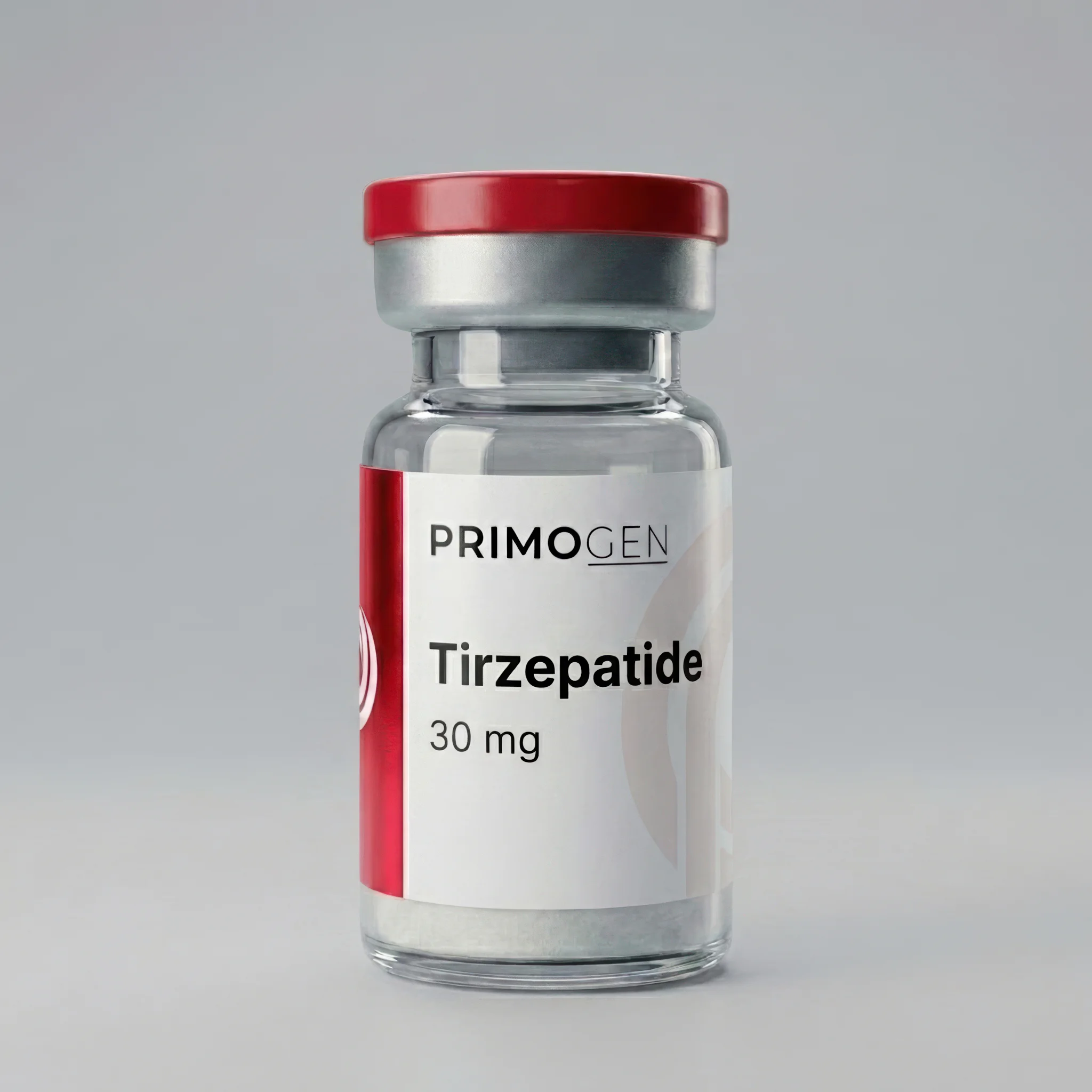
Mix the powder with bacteriostatic (BAC) water, swirl gently to dissolve, and store the mixed vial in the fridge. Tirzepatide ships as a lyophilised (freeze-dried) powder in a vial that you mix yourself. Use bacteriostatic (BAC) water only. Never use plain sterile water. The benzyl alcohol in BAC water is what lets you draw from the same vial over several days without it spoiling. Primogen supplies BAC water for exactly this.
A standard worked example for a 5 mg vial:
- Wipe the vial stopper with an alcohol swab.
- Slowly inject 1 ml of BAC water down the inside wall of the vial. That gives a strength of 5 mg/ml.
- Swirl gently to dissolve. Do not shake.
- At 5 mg/ml, 0.2 ml draws a 1 mg dose. (For Steve's microdosing, roughly a third of a 5 mg vial is about 1.66 mg.)
Store the mixed vial in the fridge (2 to 8°C), away from light, and use it within about 30 days. Inject subcutaneously, meaning into the fat just under the skin. Use a short insulin needle. A 31G, 5/16-inch pin into the belly, thigh or outer arm works well. Rotate your injection sites. If you are also running BPC-157 or other injectable peptides, keep the injection sites at least an inch apart. Start low to see how you tolerate it, and do not overshoot. An accidental large first dose is a fast track to severe vomiting.
On quality, read the certificate of analysis (COA) for whatever you buy. A COA is the lab report for a batch. It helps to know what it does and does not prove.
What are the side effects of tirzepatide?
The most common side effects in trials are stomach-related and linked to dose: nausea, vomiting, diarrhoea and constipation. They are worst while the dose is going up, and ease after. Because the drug is so heavily studied, its side effects are well understood. Here are the common ones in detail:
- Nausea is the main one, affecting more than a quarter of users. It hits hardest in the first couple of weeks. It flares briefly each time you step the dose up, then settles. The GIP part is thought to soften it somewhat compared with pure GLP-1 drugs.
- Vomiting, diarrhoea and constipation are all common and follow the same pattern. They are worst on the way up, and ease as your body adapts.
- Fatigue shows up for some people on its own.
The slower-building issues deserve the most attention:
- Lean-mass loss. In the SURMOUNT-1 DXA substudy (Look, 2025), about 25% of total weight lost was lean mass, meaning muscle and other non-fat tissue. (DXA is a type of body scan.) Tirzepatide is not a steroid, and it does not build muscle. The trial research pairs fast weight loss with enough protein and strength training to protect lean mass. Protein is commonly cited at 1.8 to 2.2 g per kg of body weight.
- Weight regain on stopping. SURMOUNT-4 (Aronne, JAMA 2023) is the key trial here. Of the people who stopped after the lead-in period, 82% regained at least a quarter of what they had lost within a year. Their metabolic markers drifted back too. The trial data treats tirzepatide as a long-term tool, not a one-off course.
- Heart rate rose a little across trials of this drug class, by roughly a few beats per minute. The rise is smaller for tirzepatide than for retatrutide.
- Bone density seemed to fall in step with weight loss, rather than as a direct drug effect. The signal was slightly larger in people without diabetes (Liu, J Clin Endocrinol Metab 2026). A DXA scan is worth considering with fast weight loss, or after menopause.
- Hair shedding (telogen effluvium) is reported. According to Dr. Ksenia (MD), GLP-1 drugs are not thought to cause it directly. It is linked to the stress of fast weight loss, not eating enough, and nutrient gaps (protein, iron, zinc).
Rare but serious risks apply across the whole class: pancreatitis (inflammation of the pancreas) and gallbladder trouble. Gallbladder problems are linked to fast weight loss in general. The label also carries a thyroid tumour warning based on rodent studies, and it is unclear whether this applies to humans. A personal or family history of medullary thyroid cancer is treated as a reason not to use it. The community also flags a couple of things. Heavy lifts that push up pressure in the belly (leg press, reverse hypers) soon after a dose are linked to sudden nausea. And the label notes that this drug class can lower blood sugar, so hypoglycaemia (blood sugar dropping too low) is a documented risk.
Why choose tirzepatide over retatrutide?
Researchers usually choose tirzepatide over retatrutide for its longer evidence base. It has the longest Phase 3 record, and the only FDA label, among the GLP-1 compounds Primogen stocks. Here is what sets it apart:
- The FDA-approved option, with the longest clinical-trial record of the GLP-1s we stock.
- The strongest appetite effect milligram for milligram among the leading GLP-1s, as reported in comparison studies.
- A smaller rise in heart rate than retatrutide across trials.
- A friendlier price than the newer triple agonist.
Beyond the main fat-loss research, the community reports using it in a few ways. In fitness, it is used for appetite control. Bodybuilders use it in cutting phases, commonly at 5 to 7.5 mg a week. They stop a couple of weeks before a contest, so the gut can recover in time for the carb-up. The wellness and longevity crowd uses small microdoses below the clinical range. Their focus is on insulin sensitivity and heart and metabolic health, rather than maximum weight loss. None of the below-clinical patterns have been tested in trials.
For the strongest effect and the widest metabolic benefits on a newer compound, retatrutide is the heavier tool. For the most proven, best-tolerated and better-value option, tirzepatide is the pick. That is why it stays on our shelf.
Referenced products
Take the 2-minute protocol quiz for a recommendation tailored to you.
Build your stackFrequently asked questions
Is tirzepatide better than semaglutide?
On weight loss, yes, by a clear margin. In the SURMOUNT-5 head-to-head trial, people on tirzepatide lost -20.2% against -13.7% on semaglutide over 72 weeks. In practice, roughly 5 mg of tirzepatide matched a full 2.4 mg dose of semaglutide. Semaglutide's main remaining advantages are a pill form and a slightly longer heart outcome history. On weight, tirzepatide wins.
Is tirzepatide the same as Mounjaro and Zepbound?
Yes, it is the same molecule. Mounjaro is Eli Lilly's brand for type 2 diabetes. Zepbound is the brand for obesity and obstructive sleep apnoea. Research-grade tirzepatide is the same active peptide. It comes as a freeze-dried powder you mix yourself, rather than in a pre-filled pen.
How do you dose tirzepatide?
The clinical schedule starts at 2.5 mg weekly for four weeks. This is a tolerance dose, not a weight-loss dose. It then climbs by 2.5 mg every four weeks toward 5 to 15 mg. Many in the community run lower split doses, for example 1 mg three times a week, for fewer side effects. But no trial has tested doses below 2.5 mg/week, so treat microdosing as community practice, not proven.
What are the side effects of tirzepatide?
In the trials they are mostly stomach-related: nausea, vomiting, diarrhoea and constipation. They are worst while the dose goes up, and ease after. The two that need the most attention are lean-mass loss and weight regain after stopping. In the DXA substudy, lean mass was about a quarter of total weight lost, and the research pairs this with protein intake and strength training. Pancreatitis and gallbladder issues are rare but serious risks across the class.
Does weight return after stopping tirzepatide?
In the trial data, often yes. SURMOUNT-4 found that 82% of people who stopped after the lead-in regained at least a quarter of their lost weight within a year. The trials treat tirzepatide as a long-term tool. A slow taper is preferred over a sudden stop, along with the training and eating habits studied alongside it.
Can I stack tirzepatide with other peptides?
People often run it alongside compounds like BPC-157 or growth hormone secretagogues, keeping injection sites apart. Running two GLP-1 drugs at once is a bad idea. You just double the side effects for no real gain. Switching between, say, tirzepatide and retatrutide is simple: stop one, start the other, and build the dose back up from a low start.
Sources (13)›
- 1.Jastreboff et al. SURMOUNT-1, NEJM 2022 nejm.org ↗
- 2.SURMOUNT-1 3-year extension, NEJM 2024 nejm.org ↗
- 3.Look et al. SURMOUNT-1 DXA substudy, Diabetes Obes Metab 2025 dom-pubs.onlinelibrary.wiley.com ↗
- 4.Aronne et al. SURMOUNT-4 (withdrawal), JAMA 2023; Horn et al. JAMA Intern Med 2025 jamanetwork.com ↗
- 5.Aronne et al. SURMOUNT-5 (head-to-head vs semaglutide), NEJM 2025 nejm.org ↗
- 6.Malhotra et al. SURMOUNT-OSA, NEJM 2024 pmc.ncbi.nlm.nih.gov ↗
- 7.Loomba et al. SYNERGY-NASH, NEJM 2024. DOI 10.1056/NEJMoa2401943
- 8.Nicholls et al. SURPASS-CVOT, NEJM 2025 acc.org ↗
- 9.Borlaug et al. SUMMIT (HFpEF) secondary, Nat Med 2025 nature.com ↗
- 10.Schneck et al. Tirzepatide population PK, CPT:PSP 2024 (PMID 38356317) ascpt.onlinelibrary.wiley.com ↗
- 11.Liu et al. BMD in GLP-1RA users, J Clin Endocrinol Metab 2026 doi.org ↗
- 12.FDA NDA 215866 Clinical Pharmacology Review accessdata.fda.gov ↗
- 13.Retatrutide TRIUMPH-1 Phase 3 (obesity, 80 weeks), NEJM, 29 Sep 2026 nejm.org ↗