
Retatrutide vs Tirzepatide vs Semaglutide: Which GLP-1 Is Right For You?
Written against the cited studies. Last updated 2 Oct 2026
Key takeaways
Retatrutide vs tirzepatide comes down to receptors and trial numbers. A receptor is a docking point on a cell that a hormone or drug switches on. Tirzepatide acts on two receptors (GLP-1 + GIP). It is FDA approved, and trials reported around 21 to 23% body-weight loss. Retatrutide adds a third receptor (glucagon). In Phase 3 it reached around 25 to 28% at 80 weeks, and close to 30% by two years. It is the stronger option, but also the newest, with the least long-term safety data.
At its core, fat loss comes down to one thing: energy in versus energy out. If you take in more energy (calories) than you burn, the extra is stored as fat. If you burn more than you take in, your body dips into those stores. This is basic physics, and nothing gets around it, not a peptide and not a drug. GLP-1 drugs work on the "energy in" side by reducing appetite. All three compounds below are GLP-1 drugs, and that is the starting point for telling them apart.
Three compounds lead the weight-loss conversation right now. People often use the names as if they were the same drug, but they are not. Semaglutide (sold as Ozempic and Wegovy) started it all. Tirzepatide (Mounjaro and Zepbound) pushed the trial results further. Retatrutide is the newest, and it is posting the biggest trial numbers of the three. It still goes by its lab name because it has not been branded yet.
The difference between them is simpler than it sounds. Each one acts on one, two or three metabolic receptors. As a rule, more receptors has meant more weight loss in trials, and more to keep an eye on.
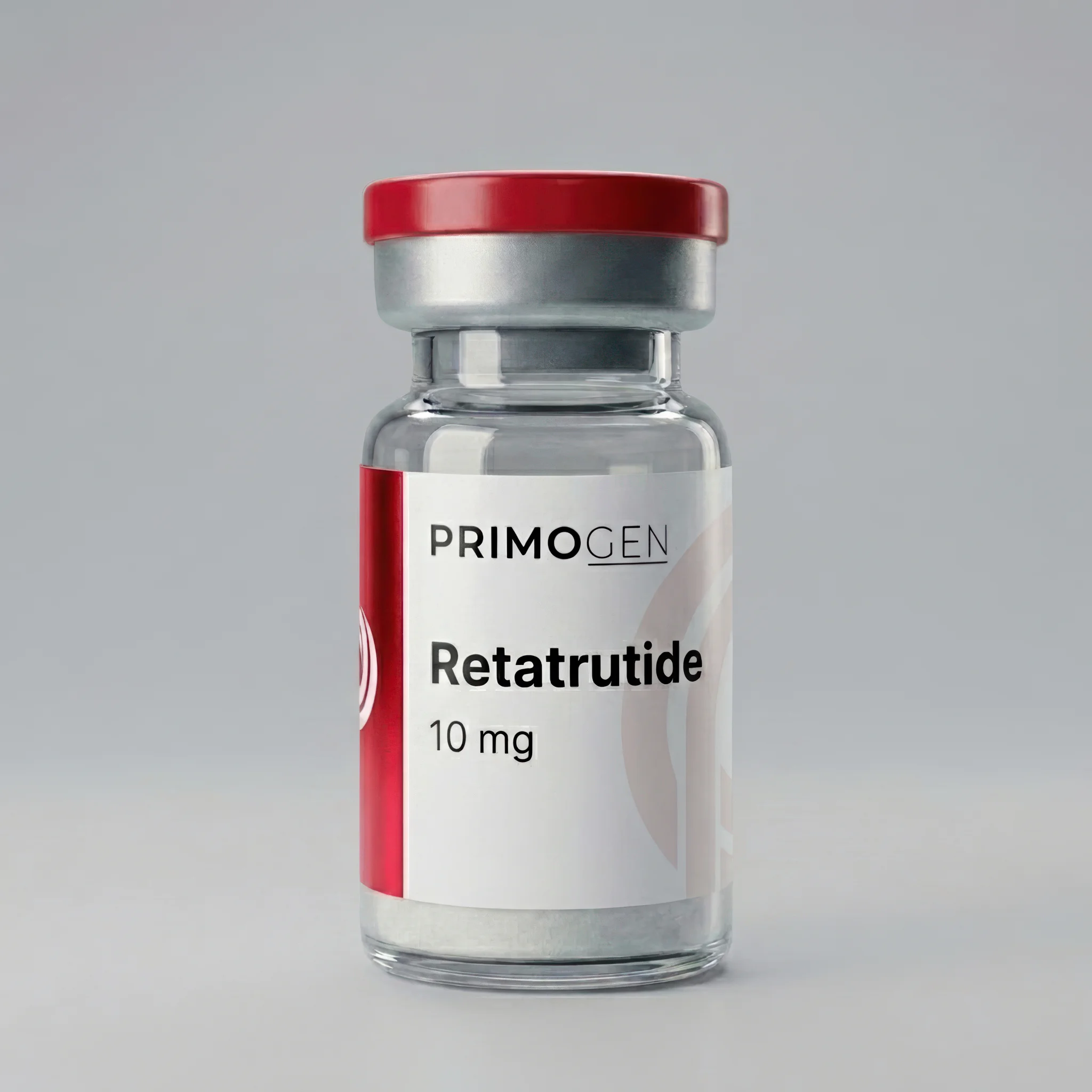
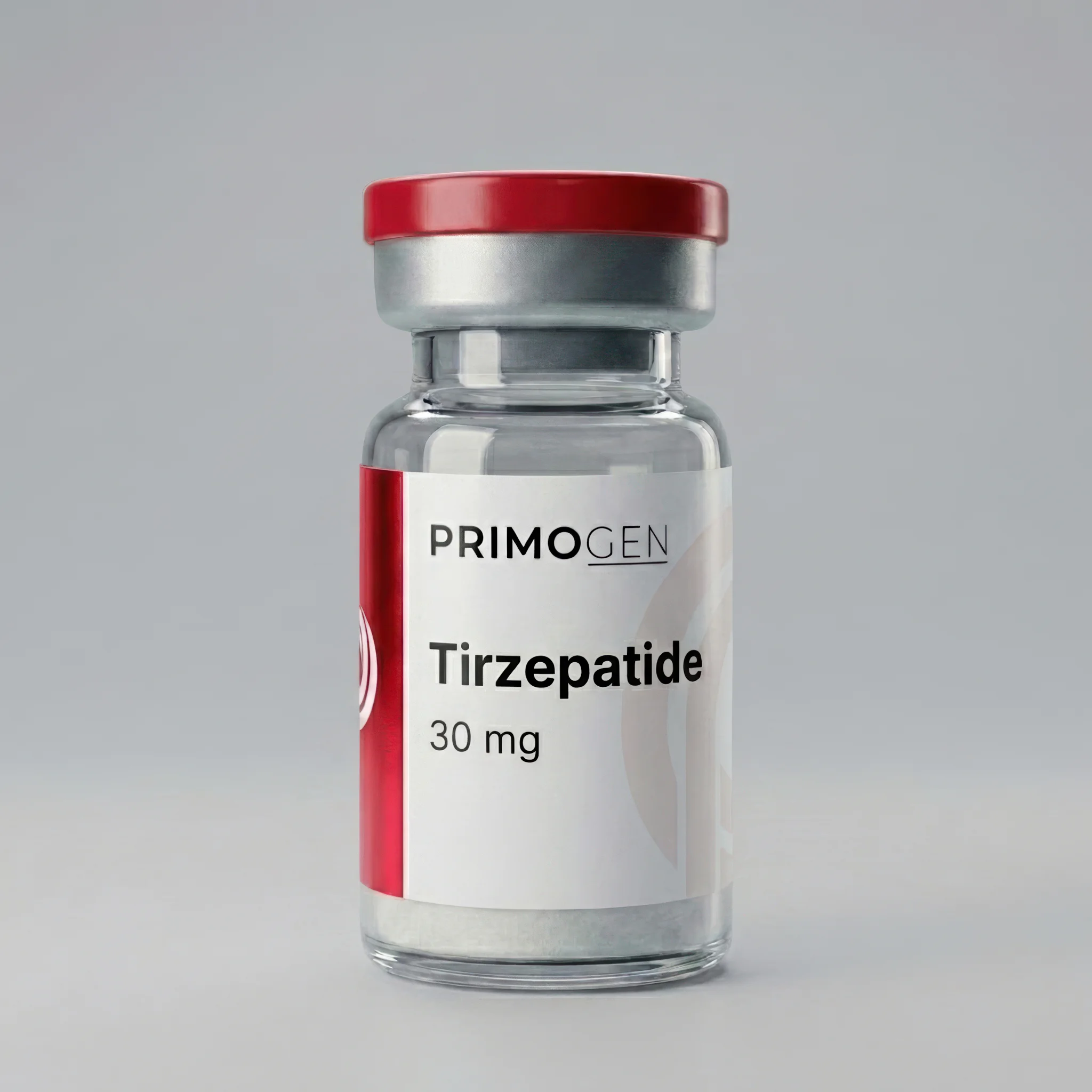
A quick note on where we stand. Primogen carries retatrutide and tirzepatide, but not semaglutide. The reasons are below. All three are sold as research compounds. This guide sorts what is well proven from what is still playing out.
Retatrutide vs tirzepatide vs semaglutide: how do they compare at a glance?
In short, semaglutide is the single-receptor original (about 15% in trials). Tirzepatide is the dual-receptor middle ground (about 16 to 22.5%). Retatrutide is the triple-receptor newcomer. It reached about 24% in Phase 2. In Phase 3 it reached 25% at 80 weeks, and close to 30% by two years. The full side-by-side is below.
| Semaglutide | Tirzepatide | Retatrutide | |
|---|---|---|---|
| Brand names | Ozempic, Wegovy | Mounjaro, Zepbound | None yet (Phase 3) |
| Receptors | GLP-1 | GLP-1 + GIP | GLP-1 + GIP + glucagon |
| Class | Single agonist | Dual agonist | Triple agonist |
| Status | FDA approved | FDA approved | Phase 3, approval expected |
| Trial weight loss | ~15% (STEP) | ~16 to 22.5% (SURMOUNT-1) | ~24% Phase 2; 25% at 80 weeks and ~30% by two years in Phase 3 |
| Half-life (time to clear half a dose) | 7 to 10 days | ~5 days | 6 to 14 days |
| How often | Weekly | Weekly | Weekly (or split) |
| Stands out for | Most data, lowest cost | Proven balance of strength and evidence | Strongest effect, widest metabolic benefits |
| Watch for | Beaten by the others | Stomach side effects | Higher heart rate, newest data |
| Stocked by Primogen | No | Yes | Yes |
How do the three compounds differ in how they work?
They differ in how many receptors each one switches on. Semaglutide hits one (GLP-1). Tirzepatide hits two (GLP-1 + GIP). Retatrutide hits three (GLP-1 + GIP + glucagon). All three are built to copy the gut hormones your body releases after a meal. The number of receptors is the main difference in how they work.
Semaglutide is a pure GLP-1 agonist. An agonist is a molecule that switches a receptor on. Here, the receptor is the docking point for GLP-1, one of the gut hormones released after a meal. In published research, semaglutide acts on the hunger signals in the brain. It also slows how fast the stomach empties, and it improves blood sugar control. (Coskun et al. 2022 describes how the drugs in this class act on their receptors.) That single mechanism is the basis of Ozempic and Wegovy.
Tirzepatide adds GIP, a second gut hormone that works alongside GLP-1. In research, adding GIP is linked to better insulin sensitivity, meaning the body responds to insulin more easily. In trials, tirzepatide also gave more weight loss than semaglutide, with similar stomach side effects. That gap in the trials is how tirzepatide, as Mounjaro and Zepbound, became the benchmark dual agonist.
Retatrutide adds a third receptor, glucagon. Glucagon is a hormone that releases stored energy, and it changes how the molecule behaves. In lab and animal studies, switching on the glucagon receptor helps the body break down stored fat and clear fat from the liver. It can also raise the energy the body burns at rest (Coskun et al. 2022). The liver results have since shown up strongly in human trials. The extra calorie burn has only been shown in animal studies so far, and human data on it has not been published. This extra mechanism is part of why retatrutide posts the highest total weight-loss figures of the three in trials. It also sits behind the wider metabolic findings further down.
In short: semaglutide and tirzepatide act mainly on appetite. Retatrutide acts on appetite too, but its glucagon part also works on stored fat and the liver.
One more detail is worth knowing. Milligram for milligram, retatrutide's effect on appetite in trials is a little weaker than tirzepatide's, and it can fade a little faster. So its edge in trials does not come from stronger appetite control. It comes from acting on fat in more ways at once.
What does the trial data show on weight loss?
In the main trials, average body-weight loss climbs with each added receptor. It is roughly -15% for semaglutide and up to -22.5% for tirzepatide. For retatrutide it is up to -24.2% in Phase 2. In Phase 3 it is 25% at 80 weeks, rising to close to 30% by two years. Here is the breakdown for the trials that got each compound approved, or for retatrutide, the trials still running:
- Semaglutide (STEP program): roughly -15% average body-weight loss at the 2.4 mg weekly dose.
- Tirzepatide (SURMOUNT-1): -16.0% / -21.4% / -22.5% at 72 weeks for the 5 / 10 / 15 mg doses.
- Retatrutide, Phase 2 (Jastreboff et al. 2023, NEJM): up to -24.2% at 48 weeks on 12 mg. Weight was still falling when the study ended.
- Retatrutide, Phase 3 (TRIUMPH-1): Lilly first announced the results in May 2026 (AJMC topline). The full peer-reviewed paper followed in NEJM in September 2026. People on 12 mg lost 25.0% of their body weight on average at 80 weeks, against 3.9% on placebo. Among people who stayed on treatment, the figure was 28.3%. By two years it reached 29.9%. That is the strongest non-surgical weight-loss result reported so far.
Keep in mind that trial figures come from supervised dosing. That means proper titration (raising the dose slowly in steps) and clinical support. So results reported in everyday use are usually lower.
What sets retatrutide apart from the other two?
What sets it apart is the range of health findings in its trials, not just the weight-loss number. Beyond the scale, retatrutide's Phase 2 data, most of it peer-reviewed, reports changes across several metabolic markers:
- Liver fat: in one Phase 2 study, liver fat fell by 82% at 24 weeks and by 86% at 48 weeks on 12 mg (Sanyal et al. 2024, Nature Medicine). This is credited to the glucagon part.
- Blood fats: the same Phase 2 dataset reported drops in triglycerides (~40%), a type of blood fat, and LDL cholesterol (~22%), the main "bad" cholesterol. Both were at 48 weeks on 12 mg (Healio / ADA 2023 coverage).
- Blood sugar: the Phase 2 trial in type 2 diabetes reported better blood sugar control (Rosenstock et al. 2023, Lancet).
- Metabolic rate: in animal studies, the glucagon part raised the energy burned at rest, so it does not rely on appetite alone. Human data on this has not been published yet.
Lilly is fully committed. The TRIUMPH program runs from TRIUMPH-1 through TRIUMPH-8, plus a dedicated cardiovascular outcomes trial. Together they cover obesity, diabetes and long-term health. That is the same road semaglutide and tirzepatide took before they became household names. Approval is widely expected. When it comes, retatrutide will almost certainly get a brand name of its own. Until then, it sits in the research-compound window under its original name.
Retatrutide is the newest of the three, so it has the least long-term safety data behind it. Its effect on heart attacks and strokes will not be known until the TRIUMPH-Outcomes trial finishes, which is due in 2029.
Why does Primogen not stock semaglutide?
Because the trial data has moved past it. Tirzepatide and retatrutide both report greater weight loss, so Primogen carries those two rather than the most famous name out of habit. Semaglutide was the breakthrough that started all of this. If it is what you want, that is a perfectly reasonable choice. It is just not part of our range.
Is weight regained after stopping a GLP-1?
In the trials where people stopped, yes. A large share of the lost weight came back within a year. The research explains why. These compounds work by turning down appetite. When they leave the body, appetite and food noise (the constant thinking about food) come back. Weight loss also lowers your metabolic rate, as the body defends its old set-point, the weight it is used to.
In the STEP 1 extension, people regained roughly two-thirds of their lost weight in the year after stopping semaglutide (Wilding et al. 2022, STEP 1 extension). In SURMOUNT-4, 82% regained at least a quarter of what they had lost after tirzepatide was stopped (Aronne et al. 2023, JAMA). There is no published stopping data for retatrutide yet. Researchers take this to mean these are long-term tools. The time on them is best used to build training and eating habits that help hold the result.
What side effects do these compounds have in the trials?
The side effects reported are broadly similar across all three, and mostly stomach-related: nausea, vomiting, diarrhoea and constipation. In the trials they go up with the dose and are strongest while the dose is being raised. They tend to ease over time.
- Nausea is the most talked about. In retatrutide trials it ranged from about 14% at low doses up to about 45% at 12 mg. The other two show a similar pattern.
- Heart rate rose across this class in the trials, and most of all with retatrutide. On retatrutide it went up a little at the higher doses, peaked around week 20, then eased back. This is worth thinking about for anyone with an existing heart concern, or anyone who uses stimulants.
- Dysesthesia means odd skin sensations, such as tingling or extra sensitivity. It is a newer signal specific to retatrutide. It was reported in up to around 21% of people on 12 mg in Phase 3. It was rarely a reason people stopped, but it is on record.
- Rare but serious: pancreatitis (inflammation of the pancreas) and gallbladder problems are risks across the whole class, reported for all three.
One thing researchers watch closely is lean-mass loss, meaning the loss of muscle and other non-fat tissue. When appetite falls sharply, people can end up eating less protein. Then some muscle can be lost along with the fat. The standard answer in the research is strength training and enough protein. This is the most-cited way to protect muscle during weight loss.
How are these compounds typically dosed in research?
Both are once-weekly compounds in the trial protocols. They start at a low dose and are raised over several weeks. The slow climb is the biggest factor in how well people tolerate them. The trial schedules are:
- Tirzepatide: 2.5 mg weekly to start, rising toward 5 to 15 mg.
- Retatrutide: low starting doses, raised step by step. In the research, most weight-loss protocols sit at or below the 12 mg tested in trials. Research use usually stays in the lower 3 to 4 mg range.
A worked mixing example (handling, not a dosing instruction). Take a 10 mg vial of tirzepatide mixed with 1 mL (100 units) of bacteriostatic water. That gives a strength of 10 mg per 100 units. So 1 unit on a U-100 insulin syringe holds 0.1 mg. A 2.5 mg measure is therefore 25 units, drawn to the syringe's 25-unit mark. A 5 mg measure is 50 units. If you mix the same 10 mg vial with 2 mL instead, the strength halves to 0.05 mg per unit. Then a 2.5 mg measure becomes 50 units. Same vial, different amount of water, different mark on the syringe. That is exactly why you should write down how much water you added, not guess.
Some researchers also microdose these, using small weekly amounts below the usual treatment doses. They do this when the interest is in metabolic and longevity markers rather than maximum weight loss. They accept a smaller effect in return for fewer reported side effects. The retatrutide deep-dive and the tirzepatide deep-dive lay out the full protocols. Our guide on how to reconstitute and dose covers the maths in detail.
How much do retatrutide and tirzepatide cost, and how do you assess quality?
Both sit at the premium end. Retatrutide costs a little more, as the newer compound. Live prices are in the table below.
On quality, read the certificate of analysis (COA) for whatever you buy. A COA is the lab report for a batch. It helps to know what it does and does not prove. There is a plain-English walkthrough in how to read a COA.
Referenced products
Which one should you choose: retatrutide or tirzepatide?
The short answer: choose retatrutide if you want the strongest option and are comfortable with the newest safety record. Choose tirzepatide if you want the FDA-approved compound with the longest track record. Semaglutide is beaten by both on trial weight loss, and we do not stock it. Here is how the choice maps to different people.
Who should choose retatrutide. Someone who wants the strongest trial weight-loss figures and the widest metabolic data (liver fat, blood fats, blood sugar). Someone who does not feel the need to "earn it" by starting with something milder. And someone who is fine being on the newest of the three while its long-term record is still being written.
- Not a fit if you want a compound that is already approved, or the longest heart safety record (its outcomes trial is not due to finish until 2029). It is also not a fit if you are sensitive to a bigger rise in heart rate.
Who should choose tirzepatide. Someone who wants the FDA-approved option with the longest safety history and the gentlest effect on heart rate. It also has the strongest appetite effect milligram for milligram in trials, and a friendlier price. It is the benchmark dual agonist for good reason, which is why it stays on our shelf.
- Not a fit if your priority is the single highest weight-loss figure on record, or the widest metabolic data. On those, the trial data favours retatrutide.
Who would have chosen semaglutide. Someone who wants the single most-studied, lowest-cost name.
- Not a fit if you want the best trial weight-loss result. Both of the compounds we stock beat it in the data, which is why Primogen does not carry it.
Take the 2-minute protocol quiz for a recommendation tailored to you.
Build your stackFrequently asked questions
Is retatrutide better than tirzepatide?
On total weight loss and the wider metabolic markers, the trial data leans clearly toward retatrutide. The difference is how mature the evidence is. Tirzepatide is FDA approved, with far more long-term safety data behind it. Retatrutide posts stronger trial figures, but it is newer and showed a larger rise in heart rate. Which fits better depends on whether you put stronger trial results or a longer track record first.
Does Primogen stock semaglutide (Ozempic)?
No. Tirzepatide and retatrutide beat it in the data, so our range sticks to those two rather than the best-known name.
When will retatrutide be approved, and what will it be called?
It is deep into Lilly's Phase 3 TRIUMPH program, and approval is widely expected. Semaglutide (Ozempic, Wegovy) and tirzepatide (Mounjaro, Zepbound) both got brand names, and retatrutide almost certainly will too. For now it goes by its research name, retatrutide, or just "reta".
Can these be stacked or switched?
Running two GLP-1s at once does not make sense, according to the research. It adds to the side effects without a matching benefit. Switching between them (say, tirzepatide to retatrutide) is simple: stop one, start the other, and build the dose back up from a low start.
Is the weight regained after stopping?
In the trials where people stopped, yes. Between roughly two-thirds (semaglutide, STEP 1 extension) and a large majority (tirzepatide, SURMOUNT-4) of the lost weight came back within a year of stopping. Researchers see these as long-term tools. Training and eating habits are the factor linked to holding on to a result.
Is lean-mass loss a concern?
The trials flag it for both. When appetite falls sharply, people may eat less protein, and some muscle can be lost along with fat. The most-cited answer in the research is strength training paired with enough protein.
Sources (11)›
- 1.Jastreboff et al. Retatrutide Phase 2, NEJM 2023 pubmed.ncbi.nlm.nih.gov ↗
- 2.Coskun et al. Retatrutide pharmacology, Cell Metab 2022 pubmed.ncbi.nlm.nih.gov ↗
- 3.Sanyal et al. Retatrutide liver-fat reduction, Nat Med 2024 pubmed.ncbi.nlm.nih.gov ↗
- 4.Rosenstock et al. Retatrutide in type 2 diabetes Phase 2, Lancet 2023 pubmed.ncbi.nlm.nih.gov ↗
- 5.Healio / ADA 2023 coverage (TG -40%, LDL -22% at 48 wk on 12 mg) healio.com ↗
- 6.Lilly TRIUMPH-1 topline, AJMC May 2026 ajmc.com ↗
- 7.TRIUMPH-1 Phase 3 (obesity, 80 weeks), NEJM, 29 Sep 2026 nejm.org ↗
- 8.TRIUMPH-1 trial registration, ClinicalTrials.gov NCT05929066 clinicaltrials.gov ↗
- 9.TRIUMPH-Outcomes (cardiovascular), ClinicalTrials.gov NCT06383390 clinicaltrials.gov ↗
- 10.Aronne et al. SURMOUNT-4 (tirzepatide withdrawal), JAMA 2023 doi.org ↗
- 11.Wilding et al. STEP 1 extension (semaglutide withdrawal), DOM 2022 ncbi.nlm.nih.gov ↗