
GHK-Cu Benefits: The Copper Peptide for Skin, Hair and Repair
Written against the cited studies. Last updated 6 Oct 2026
Key takeaways
GHK-Cu is a copper peptide for your skin. In research, it signals the cells that build skin to make more collagen and elastin, the proteins that keep skin firm and springy. That is why it turns up in serums and creams aimed at firmer skin and softer fine lines. It also helps wounds repair in lab and animal studies. Controlled trials of creams and serums are the strongest data. Injecting it is a community practice built on that data, not something proven in human trials.
GHK-Cu is a rare peptide whose science is older than most of the people using it. It was first isolated from human blood plasma in 1973. It is not a lab invention: the human body makes it on its own. Levels in the blood are reported to fall with age. They drop from around 200 ng/mL at age 20 to roughly 80 ng/mL by 60, according to a review by Pickart and Margolina (Int J Mol Sci 2018).
In plain terms, it is a copper tripeptide. Three amino acids (glycine, histidine and lysine) wrap around a single copper ion. It is written as Gly-His-Lys·Cu. The copper is the whole point. The peptide acts as a carrier that brings copper to the enzymes and cells that build skin and connective tissue. This guide separates what is well-evidenced about GHK-Cu from what is promising but thin. With this compound, the gap between the two is wide.
A quick word on where Primogen fits. We stock GHK-Cu on its own and as the lead ingredient in the GLOW and KLOW blends. It is sold as a research compound. One point runs through this whole article. The strong human evidence for GHK-Cu is almost all for creams and serums, known as topical use. The injectable route that gets the most attention is largely carried over from that evidence. We will keep flagging which is which.
What does GHK-Cu actually do for you?
Here is what people report, in everyday terms, and roughly when.
- On your skin, as a cream or serum. In the first week, a subtle glow and better hydration. Over 2 to 4 weeks, smoother texture and softer fine lines. The firmer, denser skin and shallower wrinkles that trials measure take longer, around 4 to 12 weeks. You need to keep using it to keep the results. They fade over a few months after you stop.
- As an injection. Users describe skin that feels "tighter" and a general glow, and some report stretch marks fading. These are user reports, and long-term injection safety has not been studied.
- Hair. Some users report thicker hair, but not quickly. Changes, if any, tend to show around 12 to 16 weeks.
- Wounds and scars. In lab and animal studies, it helps wounds close and scars mature.
What not to expect: overnight results, or muscle. It does not build muscle, and injecting it into one spot does not grow that spot.
A few things can go the other way. Injections often sting or burn, sometimes a lot, especially if the mix is too strong. Injecting the same spot again and again can leave lumps. Creams can sting on broken skin. On darker or tanned skin, injecting it into the face can leave dark marks. Face injections are a job for a trained practitioner, not something to do at home.
How does GHK-Cu work?
GHK-Cu carries copper into cells. In cell and animal models, it changes gene activity and pushes fibroblasts to make collagen and elastin. Most peptides do one or two things. GHK-Cu's reputation rests on the claim that it does thousands.
Pickart and Margolina used the Broad Institute's Connectivity Map, a large database of how compounds change gene activity in cells. Gene activity (also called expression) means how much of its protein a gene makes. They report that GHK shifts the activity of about 31.2 percent of human genes by at least 50 percent (Int J Mol Sci 2018). That is somewhere near 4,000 genes. It pushed activity up in roughly 59 percent of them and down in 41 percent.
That is the figure every vendor quotes, and it is real. But it helps to be clear about what it is. It is a pattern worked out by computer from cell-line data. It is not a measurement of your body getting younger. Wide gene activity in a dish is interesting, but it is not the same as a result in people. Keep both points in mind whenever you see "modulates 4,000 genes" on a label.
Under the headline figure, the better-grounded mechanisms are these:
- Copper delivery. GHK grips copper(II) almost as tightly as albumin, the main copper carrier in your blood. That lets it pass copper across cell walls (Pickart & Margolina 2018). Copper is the cofactor for lysyl oxidase. A cofactor is a helper molecule an enzyme needs to work. Lysyl oxidase is the enzyme that links collagen and elastin fibres together. So copper delivery sits right at the start of structural repair.
- Fibroblast stimulation. Fibroblasts are the cells that make collagen, your skin's main structural protein. In fibroblast cultures, GHK-Cu drives collagen building at nanomolar levels, meaning very dilute amounts. Maquart and colleagues first pinned this down (FEBS Lett 1988). In a rat wound model, repeated injections raised collagen, elastin and glycosaminoglycans in the new tissue (J Clin Invest 1993). Glycosaminoglycans are water-holding "filler" molecules in the skin.
- Calming inflammation. It turns down IL-6, TNF-alpha and NF-kB, which are signals that drive inflammation. It also raises antioxidant enzymes, the body's defences against molecules that damage cells. This has been shown in models including acute lung injury (Park et al., Oncotarget 2016).
- Angiogenesis, the growth of new blood vessels. It boosts VEGF, a signal that triggers new blood vessel growth, along with new capillary growth. That is good for wound repair. It is also the basis for the one real safety caveat further down.
The short version: in research models, GHK-Cu nudges the skin's repair pathways toward a more youthful pattern. The mistake is reading "broad gene effects in a dish" as "guaranteed whole-body rejuvenation". It is not that.
What does the data actually support for GHK-Cu?
What does GHK-Cu do for skin?
Skin is where the GHK-Cu evidence is strongest. The research here is unusually mature for a peptide. Controlled face-cream and eye-cream studies compared GHK-Cu with the same cream without it. Over 12-week courses, they report better skin density, elasticity, clarity and wrinkle depth. The Pickart group's review sums these up (BioMed Res Int 2015).
A randomised controlled trial (RCT) after laser treatment shows the limits well. Miller and colleagues studied skin treated after CO2 laser resurfacing. On blinded, objective measures, there was no significant difference. But patients rated their overall skin quality as significantly better with the copper peptide (Arch Facial Plast Surg 2006). That is a fair picture of the cream data overall. People often report results more strongly than objective measures show. This points to gradual changes in texture and density, not a dramatic before-and-after.
What does GHK-Cu do for wound healing?
The case for connective tissue and wound healing is solid, mostly from animal and lab studies. In these models, GHK-Cu speeds up re-epithelialisation, which is skin growing back over a wound. It also raises the collagen, elastin and proteoglycan content of new tissue (Maquart et al., J Clin Invest 1993). Proteoglycans are cushioning molecules in the tissue. This is the part of GHK-Cu's profile that overlaps with the healing peptides BPC-157 and TB-500. They pull different levers, though. That is exactly why all three turn up together in the blends below.
Does GHK-Cu help with hair?
The hair data is promising, but read it carefully. The strongest follicle result is for a close cousin, not GHK-Cu itself. AHK-Cu is a structural analogue, meaning a closely related molecule with almost the same shape. It made human hair follicles grow longer in a lab dish (Pyo et al., Arch Pharm Res 2007).
For GHK itself, the best controlled human result is a scalp RCT. It combined a GHK peptide with 5-ALA, and hair count rose significantly over six months compared with placebo (Lee et al., Ann Dermatol 2016). So it is a credible add-on in the research, with a real mechanism behind it. But it is not a stand-in for minoxidil, a widely used hair-loss treatment. And it has not yet been tested head-to-head against it.
Does GHK-Cu have anti-aging effects?
The anti-aging angle combines the gene-activity story with the antioxidant and anti-inflammatory effects. Together they make a broad "regeneration" pitch. The mechanisms are documented in research models (Park et al., Oncotarget 2016). The leap to whole-body anti-aging in humans is not proven, especially by injection. The well-supported research uses are skin, hair and repair. Any whole-body longevity claim is a theory, not a shown result.
Topical vs injectable GHK-Cu: which has the evidence?
Topical GHK-Cu, applied to the skin, is the route backed by controlled human trials. Injectable GHK-Cu gets the most community attention. But it rests on extrapolation, meaning conclusions carried over from other kinds of evidence. There are almost no controlled human trials of injections. This is the most important thing to understand before buying GHK-Cu.
Topical is the route with the evidence. It has decades of controlled cosmetic trials and an established place in skincare. Its delivery limits are well understood. Only a small fraction of the copper you apply gets through intact skin, but that is enough to act locally. For skin and scalp goals, topical is the lower-risk, better-supported path.
Injectable (sub-Q) is the route with the attention. Sub-Q, or subcutaneous, means injected into the fat just under the skin. Community dosing is typically 1 to 2 mg/day. The idea is simple: get the peptide into the bloodstream so it can reach connective tissue and hair follicles that a cream cannot reach. But there are almost no controlled human trials of injected GHK-Cu. Users are working from the cream results, lab studies and animal data. That reasoning holds up on paper. It is just not the same as proof. Anyone selling injectable GHK-Cu as if it carried the cream evidence is mixing up two very different sets of data.
One myth is worth clearing up here. Injecting GHK-Cu into a specific muscle for local "site enhancement" is mostly marketing, not a real practice. The peptide is small and clears fast. It spreads through the body rather than staying where you put it. And it stings a lot. Lumps from injecting the same spot again and again are a side effect, not a cosmetic technique.
What is the GHK-Cu dosage?
In the cosmetic trials, topical GHK-Cu runs at roughly 0.05 to 0.2 percent for face products and 1 to 3 percent for the scalp. The most-cited community injection protocol is 1 to 2 mg/day sub-Q. For the practical steps of mixing and measuring, see how to reconstitute and dose. Here are the GHK-Cu specifics:
- Topical: roughly 0.05 to 0.2 percent for face creams and serums. In the trials, these were applied twice daily over 12-week courses. Scalp products run higher, around 1 to 3 percent.
- Injectable (sub-Q): the most-cited community protocol is 1 to 2 mg/day, often before bed, into the belly. A common pattern is a 30-day cycle: 1 mg/day for two weeks, then 2 mg/day for two weeks, followed by time off. The other common pattern is 8 to 12 weeks on with a 4 to 6 week break. The reason given for the breaks is to let copper clear.
- How often: GHK-Cu has a short half-life, from minutes to a couple of hours. Half-life is the time it takes for half a dose to clear your system. So it is a daily compound. Some people split the dose. Some try adding a DPP-4 inhibitor, a drug that blocks an enzyme that breaks peptides down, to slow its breakdown. But no human study has confirmed this makes it work longer, so treat it as theory.
How do you reconstitute GHK-Cu?
GHK-Cu follows the standard peptide rules, with a few copper-specific exceptions. To reconstitute means to mix the freeze-dried powder back into a liquid. Use bacteriostatic (BAC) water only, which is what Primogen supplies. Never use sterile water.
Here is a worked example. Add 5 mL of BAC water to a 50 mg vial and you get a 10 mg/mL solution. A 1 mg research dose is then 0.1 mL. That is 10 units on a 100-unit (1 mL) insulin syringe. A 2 mg dose is 0.2 mL, or 20 units. If you mix the same 50 mg vial into 2 mL instead, you get 25 mg/mL. Then 1 mg is just 0.04 mL (4 units). But the solution is far stronger, and it stings much more. Beyond that:
- Dilute well to tame the sting. This is the big one. Use at least 5 mL of BAC water per vial rather than squeezing it into 1 mL. The solution is acidic, and the burn gets much worse as the mix gets stronger. A 25 mg/mL mix will sting a lot. Around 1 to 10 mg/mL is far more comfortable to inject.
- Keep it out of the light. Light breaks down the copper complex. Store it in the dark, ideally in an amber vial or its box.
- Use the colour as a quality check. A correct solution is clear blue to blue-purple. If it turns green or brown, goes cloudy, or forms bits (a precipitate), the copper has come loose or oxidised. Throw it away.
- Keep it in the fridge and use it within a few weeks. Mixed GHK-Cu keeps for less time than many peptides, roughly two to four weeks cold, because the copper oxidises. Do not freeze the mixed solution.
- Do not mix it with reducing or oxidising agents. These are substances that add or strip electrons, which can break the copper bond. Vitamin C (ascorbic acid) and benzoyl peroxide both break apart the copper complex. Keep them out of the same syringe. On the skin, use them at a different time of day.
For whole-body use, inject sub-Q (a 31G insulin needle into the belly or upper thigh works). For skin and scalp, use it topically. Do not inject the face. It is the most painful spot possible, and there is no good reason to when a cream exists.
What are the side effects of GHK-Cu?
At the doses commonly used, GHK-Cu is reported to be well tolerated. Most of what users report is local and minor: a sting after injecting, brief redness or a small welt. Over the long run, there are two things to watch. One is copper balance at high doses over time. The other is a theoretical caveat about blood vessel growth. Here is the detail:
- Pain after injecting is the common one. It comes from the chemistry, not contamination. The solution is acidic, so it stings. The fix is more dilution, not worry. Redness or a small welt at the site is normal and short-lived.
- Copper balance deserves real respect, even though it almost never matters at normal doses. GHK-Cu is copper by design. At 1 to 2 mg/day, the copper you add is a small fraction of a milligram. That is well under the adult upper limit of about 10 mg/day set by the IOM, a limit based on protecting the liver. Only long-term, very high dosing pushes into copper overload.
- Simple guardrails for copper. Do not run extreme doses. Balance long cycles with a modest amount of zinc, since copper and zinc compete. Around 25 mg/day is the common community move. If you use it long term, it is reasonable to check blood copper, zinc and liver enzymes at 8 to 12 weeks. A test for ceruloplasmin, the main copper-carrying protein in blood, is worth adding. Anyone with Wilson's disease (a genetic condition where copper builds up in the body) or a family history of copper-handling problems should not use copper peptides at all.
- The blood vessel caveat is theoretical, but worth stating. GHK-Cu boosts VEGF and new blood vessel growth. That is great for healing. In principle, though, it is unhelpful if you have an active or hidden tumour that would also like a blood supply (Rolland et al.). There is no human evidence that GHK-Cu causes or speeds up cancer. But the sensible approach is to avoid it if you have active or recent cancer.
- Not for pregnancy or breastfeeding, simply because there is no data.
The topical safety record is well understood. The long-term safety of daily injections over many months has not been studied yet, so keep that gap in mind.
Topical users also mention the so-called "copper uglies". This is a short phase of breakouts, clogged pores, or skin looking briefly worse when first starting GHK-Cu. It is like the "retinoid uglies" some people get with retinol creams. It comes from user reports rather than clinical studies. It does not happen to everyone, and it usually settles as the skin adjusts. If it shows up, treat it as a passing phase rather than a reason to stop. Using it less often for a while can help.
Where does GHK-Cu come from, and how do you judge quality?
Like most research peptides, GHK-Cu is mostly made in China. On your side, the quality check that matters is the certificate of analysis (COA). This is the lab report that comes with a peptide. Read the COA for your GHK-Cu and make sure you understand what it does and does not show. Once it is mixed, the colour gives you a second check: it should be clear blue to blue-purple.
How does GHK-Cu fit with the GLOW and KLOW blends?
GHK-Cu is a structure-and-skin peptide. It is not anabolic, meaning it does not build muscle, and it is not a fat-loss tool. For serious tendon or ligament repair, the healing peptides BPC-157 and TB-500 are a better fit. The research focus for GHK-Cu is collagen, skin density, scar tissue and hair, plus its broad repair signalling. Because it covers different ground from the other two, it anchors Primogen's repair blends:
- GLOW combines BPC-157 (10 mg), GHK-Cu (50 mg) and TB-500 (10 mg) in one vial. GHK-Cu covers collagen and skin. BPC-157 covers gut-lining protection and blood vessel repair. TB-500 covers cell movement and tissue remodelling, which is the body rebuilding and reorganising tissue.
- KLOW is GLOW plus KPV (10 mg), which adds an extra anti-inflammatory layer.
The blends also help with handling. BPC-157 is close to pH-neutral and easy to tolerate. Mixing it with GHK-Cu noticeably softens the copper peptide's sting. For the full breakdown of ratios, dosing and who each blend suits, see the GLOW and KLOW blends guide.
Referenced products
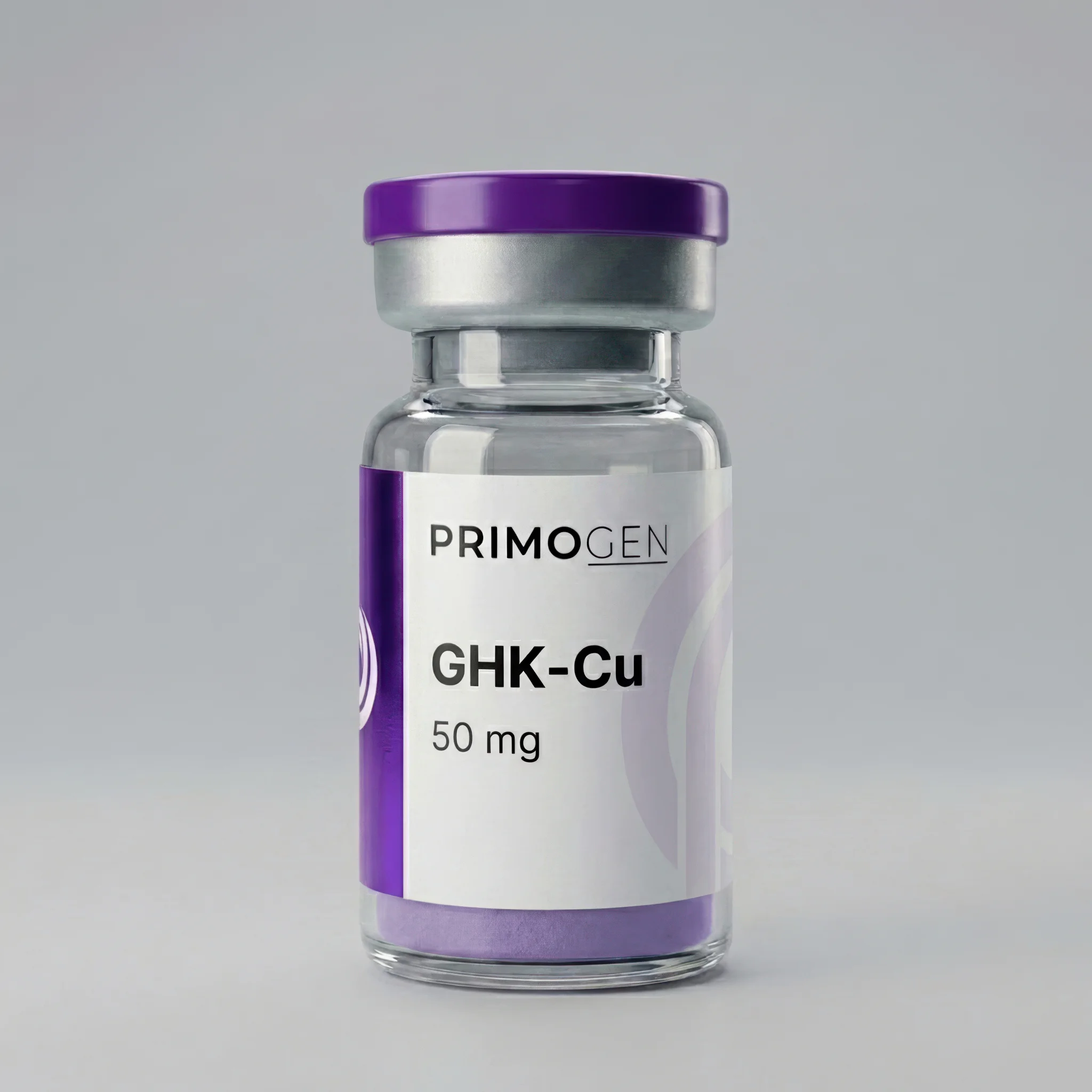
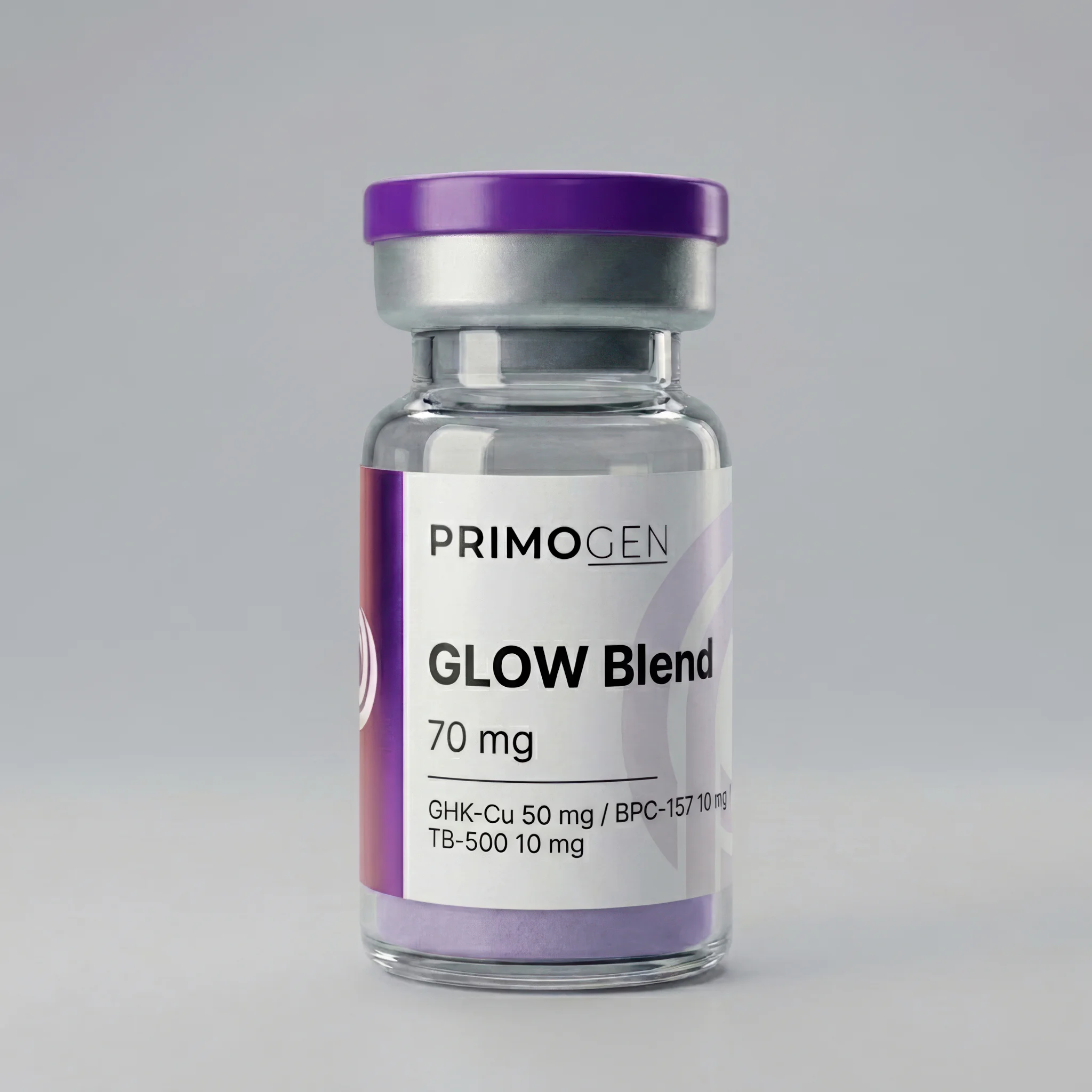
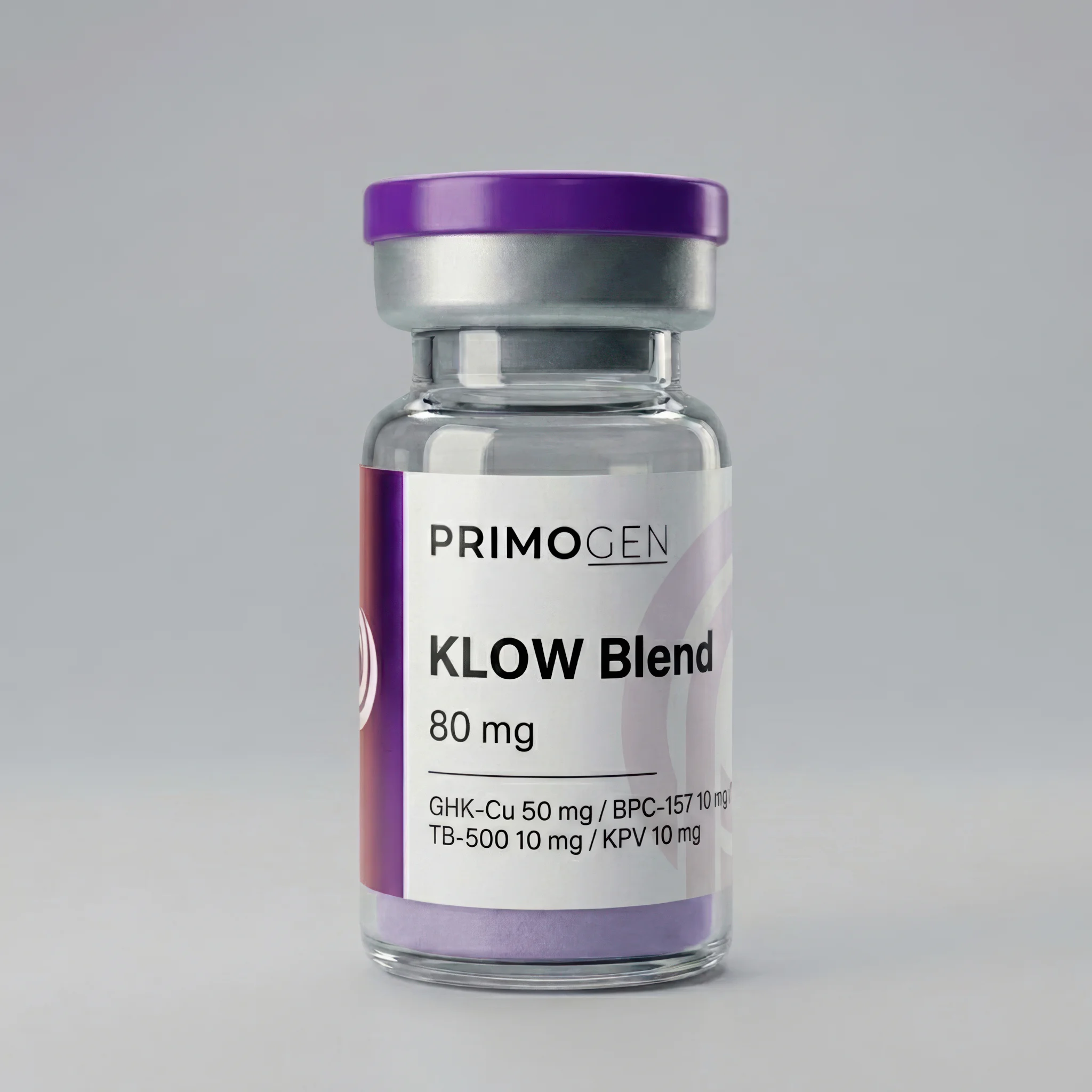
Take the 2-minute protocol quiz for a recommendation tailored to you.
Build your stackFrequently asked questions
What is GHK-Cu and what are its main benefits?
GHK-Cu is a copper tripeptide that the human body makes naturally. It is made of glycine, histidine and lysine bound to a copper ion. Its best-evidenced research uses are skin firmness, density and wrinkle depth, from controlled trials of creams. There is strong support for wound healing in animal and lab models, and a credible case for hair. It also shifts a very broad range of gene activity in cell-line data, which is behind its "regeneration" reputation.
Is topical or injectable GHK-Cu better?
For skin and scalp, topical is the route with the actual controlled-trial evidence, and it is lower-risk. The community injects it sub-Q at 1 to 2 mg/day to get it into the bloodstream. But that rests on evidence carried over from other studies, not human trials. Many people who inject also use a cream or serum. Microneedling can help a cream get into the skin.
Does GHK-Cu regrow hair?
It is a promising add-on, not a replacement for proven hair treatments. The strongest follicle data is for a related peptide, AHK-Cu. The best controlled human result for GHK is a scalp study where it was combined with 5-ALA. It is reasonable to stack for hair density. It has not yet been tested head-to-head against minoxidil.
How do I reconstitute GHK-Cu, and why does it sting?
Use bacteriostatic water only, and dilute well, with at least 5 mL per vial. The solution is acidic, which causes the burn, so the fix is more dilution, not less. Keep it cold and out of the light. Throw it away if the blue colour turns green or brown, or if it goes cloudy. The full steps are in the reconstitution guide.
Is GHK-Cu safe? What about copper?
At normal doses (1 to 2 mg/day) it is well tolerated, and the copper you add is a small fraction of the daily upper limit. Copper only becomes a real concern at high doses over a long time. Balance long cycles with some zinc, and think about blood tests if you use it long term. Avoid it completely if you have Wilson's disease or active or recent cancer, and during pregnancy and breastfeeding.
Can GHK-Cu be stacked with other peptides?
Yes, and it often is. It pairs naturally with the healing peptides BPC-157 and TB-500. That is the basis of the GLOW blend, and of KLOW, which adds KPV. The three cover different repair pathways. BPC-157 also helps soften GHK-Cu's injection sting.
Sources (12)›
- 1.Pickart & Margolina, gene-expression review, Int J Mol Sci 2018 pubmed.ncbi.nlm.nih.gov ↗
- 2.Pickart, Vasquez-Soltero & Margolina, GHK and aging review, BioMed Res Int 2015 pubmed.ncbi.nlm.nih.gov ↗
- 3.Maquart et al. fibroblast collagen synthesis, FEBS Lett 1988 pubmed.ncbi.nlm.nih.gov ↗
- 4.Maquart et al. connective-tissue accumulation in vivo, J Clin Invest 1993 pubmed.ncbi.nlm.nih.gov ↗
- 5.Miller et al. post-CO2-laser RCT, Arch Facial Plast Surg 2006 pubmed.ncbi.nlm.nih.gov ↗
- 6.Pyo et al. hair-follicle (AHK-Cu) in vitro, Arch Pharm Res 2007 pubmed.ncbi.nlm.nih.gov ↗
- 7.Lee et al. GHK + 5-ALA hair RCT, Ann Dermatol 2016 pubmed.ncbi.nlm.nih.gov ↗
- 8.Park et al. acute lung injury (anti-inflammatory), Oncotarget 2016 pubmed.ncbi.nlm.nih.gov ↗
- 9.Park et al. ACL reconstruction healing, J Orthop Res 2015 pubmed.ncbi.nlm.nih.gov ↗
- 10.IOM Dietary Reference Intakes, copper upper limit (NBK222312) ncbi.nlm.nih.gov ↗
- 11.NIH Office of Dietary Supplements, Copper fact sheet ods.od.nih.gov ↗
- 12.Rolland et al. copper / VEGF / HIF-1a signalling, PMC4741443 ncbi.nlm.nih.gov ↗